PhD students Niko Darci-Maher and Bri Baumbach have been awarded a DOE Joint Genome Institute New Investigator Grant as co-PIs on a collaborative lichen project! The Joint Genome Institute will sequence 150+ metatranscriptomes and 5 long-read metagenomes from lichen samples that Niko and Bri collected in the UC natural reserves, generating one of the biggest genomic datasets on lichens to date. They will use the data to better understand the evolution of nutritional mutualisms in microbes, and to mentor undergrads who are excited about natural history and bioinformatics. See below for more details and stay tuned for publications in the coming years!
Exploring the evolutionary maintenance of symbiosis through comparative metatranscriptomics of carbon exchange systems in wild lichens
Niko Darci-Maher, Bri Baumbach, Britt Koskella, Klara Scharnagl
What is a lichen? Any time you walk down a city street, a forest path, or a rocky shoreline, you are among many different types of lichen. Some look like dangling green fishnet stockings, while some are bright orange spiky explosions, or pale leafy rings. People once thought that lichens were plants, but in fact, lichens are partnerships of fungi and single-celled algae intertwined in symbiosis. These algae harvest the sun’s energy through photosynthesis, which allows them to create nutritious sugars. The lichen fungus absorbs some of these sugars, so both partners are fed from the algae’s photosynthetic powers. In return, the lichen fungus makes chemicals to protect the algae from drying out. This chemical trade between species allows lichens to thrive almost everywhere on Earth, and lichens can even survive in outer space. We think this win-win exchange is what holds the lichen relationship together over millions of years of evolution. However, even though we know the basics, many details of the lichen relationship remain a mystery.
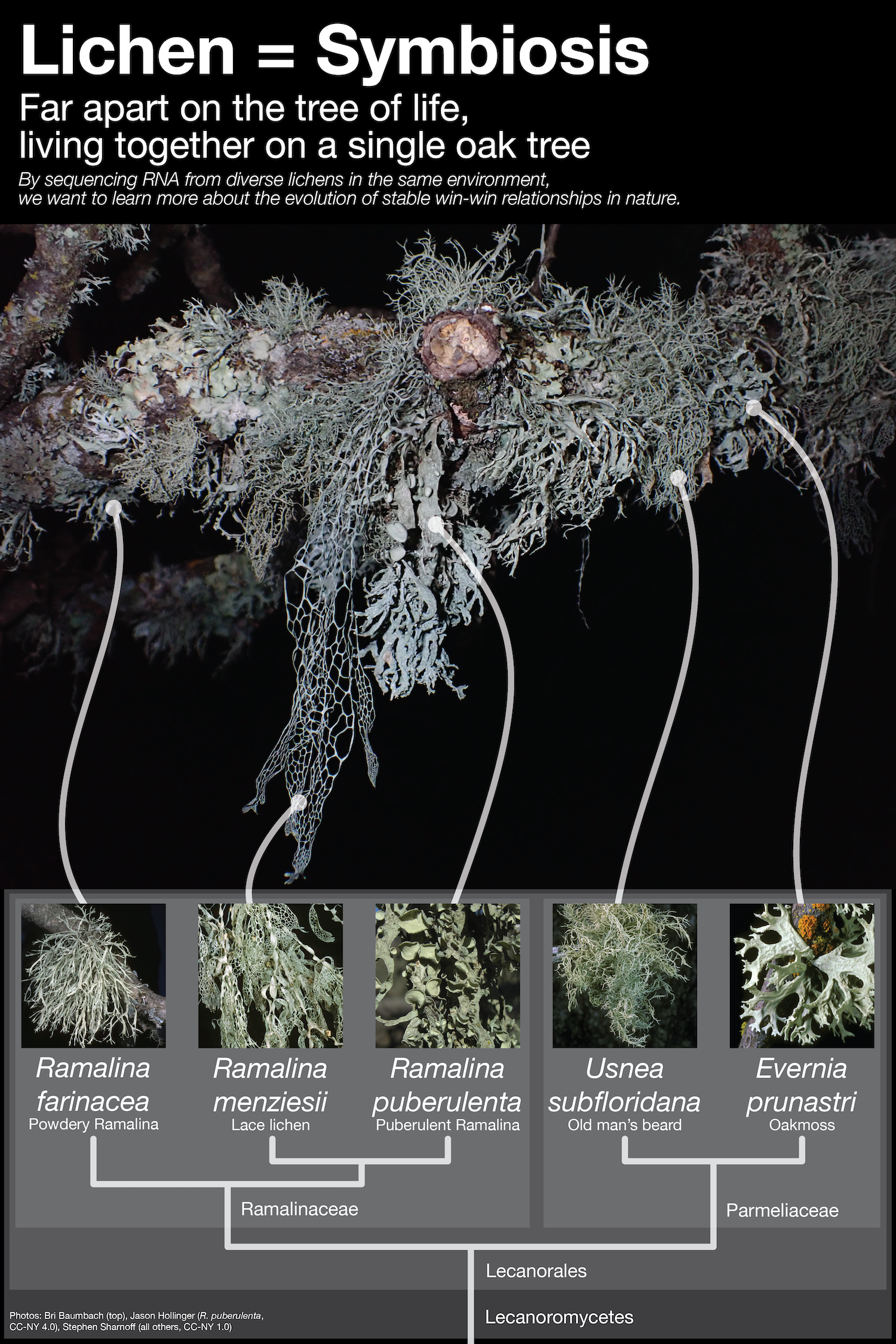
In this project, we want to learn more about the molecular exchange between the lichen fungus and algae. Given that lichens have evolved multiple times, we also want to see if different lichens have evolved the same nutrient-sharing systems. To tackle these questions, we are sequencing the RNA that is being made by the fungi, algae, and bacteria within the lichen. By measuring the RNA in the lichen fungus, algae, and bacteria, we can tell which organisms are turning on the functions that allow nutrients to flow between partners. We collected five different types of lichen, which are far apart on the tree of life but live together on a single oak tree: Ramalina farinacea, Ramalina menziesii, Ramalina puberulenta, Usnea subfloridana, and Evernia prunastri. We sampled during the daytime and nighttime, so we can compare the activity of the different lichen organisms with and without photosynthesis. This strategy will let us see how each lichen is exchanging nutrients within itself, and then compare close and distant relatives to see if they have all evolved the same mechanisms. Our results will help illuminate the evolutionary mechanisms that stabilize the lichen symbiosis, with potential implications for microbial mutualisms across the tree of life.

 Koskella Lab at UC Berkeley