
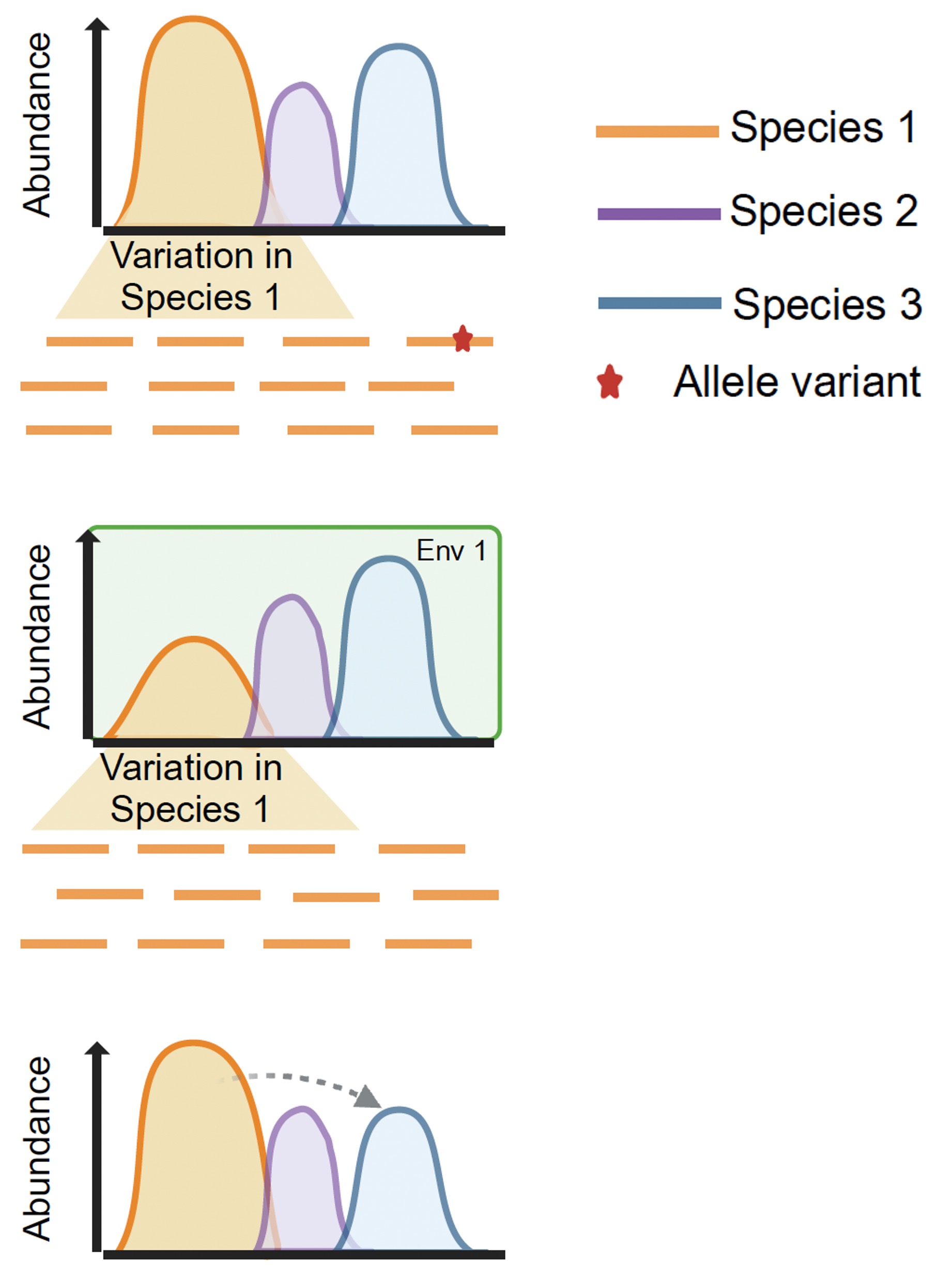
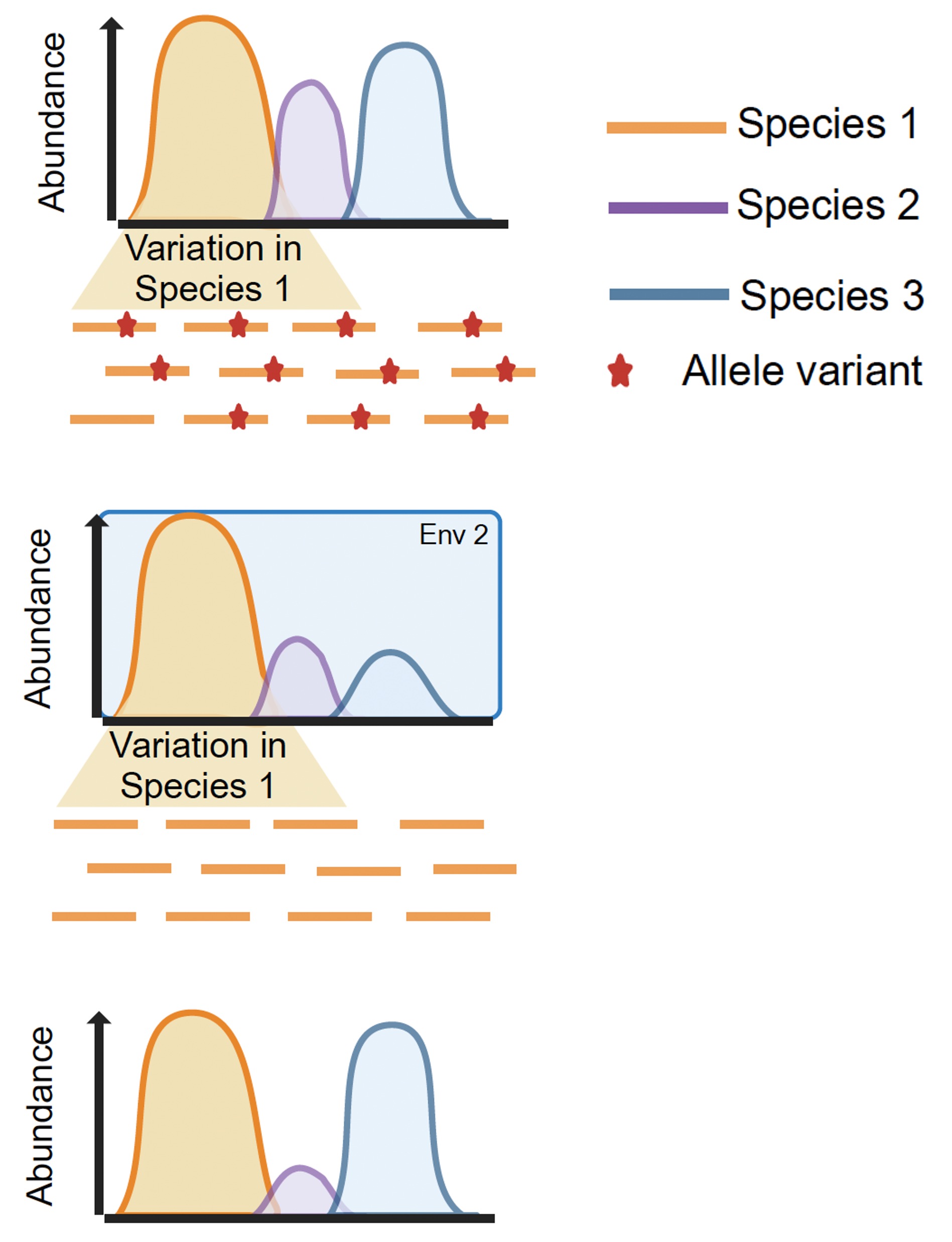
Figure 1. Changes in relative abundance of simple microbiome under different scenarios to highlight the importance of genetic resolution and the contributions of ecology and evolution. In each panel, a mock microbiome community composed of three species is depicted over two time points (T1 and T2). Below each graph are cartoon sequencing reads corresponding to Species 1. A) A toy example in which evolutionary change has occurred in Species 1 such that a de novo mutation has rose to high frequency, but it did not have an effect on the overall relative abundance of the community. B) In this example, the environmental context differs such that Environment 1 (Env 1 in green) and Environment 2 (Env 2 in blue) have different abiotic characteristics resulting in different abundances of the three species. C) Final example depicting evolutionary change influencing community structure, such that a de novo mutation emerges in Species 1, rises to high frequency, and affects its own relative abundance in the community.
Alt text: Three panels illustrating the distribution of species abundance through time, with three colored curves in a normal distribution at varying heights. Each curve represents a separate species, the width of which captures the standing genetic variation within that species (e.g. the number of strains). When panel slider moves left to right, changes in either allelic variation or species abundances are revealed.
Congratulations to postdoctoral researcher Tiffany Batarseh on a beautiful new review of ecological and evolutionary processes that shape the microbiome!
Tiffany N Batarseh, Britt Koskella, Distinguishing among evolutionary and ecological processes shaping microbiome dynamics, The ISME Journal, 2025;, wraf107, https://doi.org/10.1093/ismejo/wraf107
This paper started during a discussion over a year ago in which Dr Batarseh and I (Britt) realized we had both encountered a lot of push back over the years about how much evolution there really is in the microbiome. While we (the field) don’t yet know the answer, there is no doubt that both ecological (changing species abundances) and evolutionary (changing allele frequencies within populations) processes are at play. In this new paper, we explore the evidence for each across systems and discuss methods that can be used to differentiate the mechanisms underlying observed patterns.

 Koskella Lab at UC Berkeley