
Sciencing during a global pandemic is no joke.
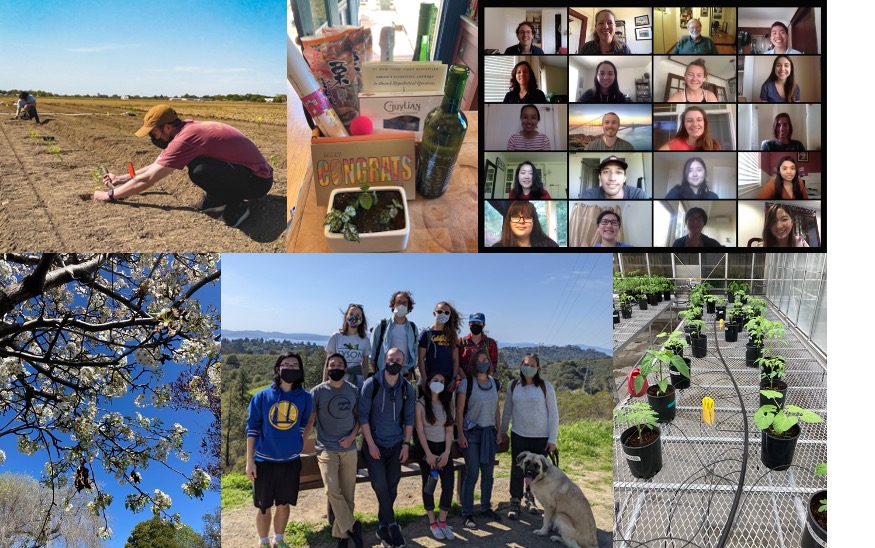
Well, you need only look at how long it has been since our last news post to see that things have been…. unusual. As COVID-19 brought the University and our lab to a grinding halt, we all had to find new ways to continue meeting (thank you Zoom), teaching, and doing research. As we slowly return to a new normal, still wearing our masks and social distancing, we finally have time to reflect on our successes despite the circumstances.
The first news is that, since the last post, Britt got tenure this past July! It was a somewhat anticlimactic event given it was just a few months after we began lockdown, but the lab group put together a fantastic gift basket and we had a great time dreaming up the next phase of the lab. On that note, this past month we had our first ever virtual lab retreat. This three day event allowed us to get back together as a team, identify shared goals and values, share new tricks and hacks, discuss failures and successes, and – of course – have some fun too! It was incredibly refreshing and left us all with a renewed sense of purpose as a group.
We have also welcomed some new lab members, including postdoctoral research fellow Kate Ennis, who is joining us from UC Santa Cruz. Kate received both a UC President’s fellowship and NSF postdoctoral fellowship to start up a new system exploring the role of phages in the floral microbiome. We were also joined by new graduate student, Emily Dewald-Wang, who came via Washington University in St Louis, and will be working on – among other things – bringing community ecology and disease ecology together using plant-microbiome interactions (including as part of the NSF CAREER – funded Pear tree project). Over the Summer and Fall, we were lucky to bring Ash Rosas onto the team as a NSURP fellow. And we can’t forget to mention to new lab mascots: Simba (a 95 pound shepherd mix who joined the lab last April) and Pili (a brand new puppy currently the size of Simba’s head but with fierce ambitions of someday taking him down.
As we said goodbye to (or prepare to say goodbye to) past members, we have lots of great news to share on their behalf: Cathy Hernandez will be wrapping up her PhD this Summer and is heading to Yale as a Donnelly fellow to work with Paul Turner on the ecology and evolution of viral thermal performance. Wenke Smets, who has been with us as a postdoctoral fellow for two years, will be returning to Belgium this Autumn to take up an independent research fellowship there, continuing to explore the phyllosphere. The undergraduate researchers in the lab are also kicking ass! Xuening Zhang graduating this past Spring and started her PhD at Cornell, working with Anurag Agrawal as a Presidential Life Science Fellow. Tristan Caro began his PhD at UC Boulder, and just received a NSF GRFP! Rachel Rovinsky received a SPUR grant to support her senior research project and will be graduating this coming Spring, after which she will be starting her PhD at UW Madison in the Microbiology Doctoral Training Program. Isabella Muscettola will be starting this Spring as a crewmember on the Grand Canyon National Park Fire Effects & Fire Monitoring Program, assisting on managed fires through data collection of fire behavior and firefighting and implementing prescribed burns. Previous AmGen summer student Nina De Luna (an undergraduate at Penn State) will be starting her PhD in the Immunology program at the University of Pennsylvania, and AmGen fellow Lina Ruiz (an undergraduate at Purchase College) will be starting her PhD at Columbia this Fall. Congratulations to you all!
In other news, graduate student Reena Debray received a Berkeley IB Summer Research Award and a Sigma Xi GIAR grant to support her work on the evolution (and loss) of phage resistance in bacterial pathogens. Graduate student Kama Chock received a UC Berkeley SMART fellowship to fund a mentored project in collaboration with an undergraduate researcher. The lab also received funding from the California Tomato Research Institute to run a set of field trials, lead by graduate student Elijah Mehlferber, this coming summer to test the role of disease protective symbionts in agricultural practice.
Finally, a few new publications to share:
- McDonald, J. E., Marchesi, J. R., & Koskella, B. (2020). Application of ecological and evolutionary theory to microbiome community dynamics across systems.
- Hernandez, C. A., Salazar, A. J., & Koskella, B. (2020). Bacteriophage-Mediated Reduction of Bacterial Speck on Tomato Seedlings. PHAGE, 1(4), 205-212.
- Mutalik, V. K., Adler, B. A., Rishi, H. S., Piya, D., Zhong, C., Koskella, B., … & Arkin, A. P. (2020). High-throughput mapping of the phage resistance landscape in E. coli. PLoS biology, 18(10), e3000877.
- Koskella, B. (2020). The phyllosphere. Current Biology, 30(19), R1143-R1146.
- Koskella, B., & Bergelson, J. (2020). The study of host–microbiome (co) evolution across levels of selection. Philosophical Transactions of the Royal Society B, 375(1808), 20190604.
- Simmons, E. L., Bond, M. C., Koskella, B., Drescher, K., Bucci, V., & Nadell, C. D. (2020). Biofilm structure promotes coexistence of phage-resistant and phage-susceptible bacteria. Msystems, 5(3).
- Smets, W., & Koskella, B. (2020). Microbiome: Insect Herbivory Drives Plant Phyllosphere Dysbiosis. Current biology, 30(9), R412-R414.
As well as PhD student Kama Chock’s new papers from his Master’s work:
- Chock, M. K., Hoyt, B., & Amend, A. S. (2021). Mycobiome transplant increases resistance to Austropuccinia psidii in an endangered Hawaiian plant. Phytobiomes Journal.
- Chock, M. K. (2020). The global threat of Myrtle rust (Austropuccinia psidii): Future prospects for control and breeding resistance in susceptible hosts. Crop Protection, 105176.

 Koskella Lab at UC Berkeley